Victoria, B.C. lək̓ʷəŋən territory: Released by the POLIS Project on Ecological Governance at the University of Victoria’s Centre for Global Studies, a new guidance document offers practical, place-based teachings for non-Indigenous researchers, decision-makers, proponents, and allies working with Indigenous Knowledge & Indigenous Knowledge holders.
Co-authored by a team of Indigenous and non-Indigenous practitioners, including POLIS Affiliates Ira Provost (Manager, Piikani Nation Consultation and Piikani Traditional Knowledge Services) and Dr. Gleb Raygorodetsky, the guidance document is informed by the authors’ shared experiences with knowledge sharing and knowledge co-production in Alberta.
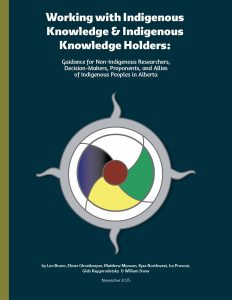
“There is a real need for this type of guidance. This document is a humble gesture and offering from the co-authors,” said Ira Provost. “As part of our responsibility to future generations, this document brings together real knowledge and teachings that are rooted in place, in Indigenous wisdom, and in the ethics of respectful knowledge sharing.”
The authors offer four guiding principles to help non-Indigenous practitioners work respectfully with Indigenous Knowledge and Indigenous Knowledge holders: ceremony, awareness, mutual respect, and shared governance. The four principles are all connected and, as described in the guidance document, should be implemented as an interdependent, integrated, and indivisible whole.
“These principles can be applied to a variety of initiatives at varying degrees, including environmental monitoring and assessment, land use studies, environmental stewardship, and wildlife management,” said Dr. Frederick Wrona (Professor, Svare Research Chair in Integrated Watershed Processes, University of Calgary; UNESCO Chairholder in Mountain Water Sustainability; Inaugural (2016-2020) Chief Scientist, Alberta Environment and Parks), who was involved in an early draft of the guidance document. “This document offers direction for non-Indigenous practitioners on building respectful relationships with Indigenous Peoples and recognizing Indigenous Knowledge as a credible, living knowledge system. In a time of growing mistrust in science-informed decision-making, it outlines culturally appropriate approaches for braiding Indigenous and Western scientific knowledge to strengthen evidence, improve trust, and support decisions grounded in respect, reconciliation, and shared learning.”
While shaped primarily by the authors’ experiences in Alberta, the guidance offered is broadly applicable to practitioners seeking to ensure that their practices and procedures honour and uphold Indigenous ways of knowing and doing.
“This is a living document that can be further refined as needed under the guidance of Indigenous Knowledge holders in Alberta to reflect evolving understandings and experiences,” said Ira Provost. “We are committed to keeping this knowledge alive for future generations and to showing what respectful inclusion of Indigenous Knowledge looks like and how these guiding principles can set a strong foundation for fostering reconciliation in action.”
-30-
Media Contacts
Gleb Raygorodetsky (POLIS Affiliate & Report Co-Author), [email protected]
Laura Brandes (Communications Director, POLIS Project), [email protected]
About the POLIS Project on Ecological Governance
The POLIS Project on Ecological Governance is a hub for collaborative and action-oriented research, policy practice, and education and an integral part of the Centre for Global Studies at the University of Victoria. Since being founded in 2000, the work of POLIS has encompassed a number of initiatives, each embodying the principles of ecological governance and working towards a responsible present that supports a sustainable future. Current POLIS initiatives include the POLIS Water Sustainability Project, the POLIS Wildfire Resilience Project, and the POLIS Biocultural Ethics Initiative.


